
Ingredient file // Flavor
Whey
A milk sugar and flavor, not a protein source
Whey is the liquid drained off when milk becomes cheese, usually dried to a powder. Plain dried whey is mostly lactose with a little protein, so in a dog food it adds a milky flavor and some calories, not meaningful protein.
Role in the food Does a job- What it is
- The watery part of milk drained off during cheesemaking, usually dried into a sweet, milky powder.
- Made from
- Milk left over from cheese production
- Main job
- Milky flavor dogs like
- Typical amount
- Not published
- Watch for
- Dogs with dairy allergy or lactose trouble
- Not the same as
- Whey protein concentrate
Straight answer
Is Whey safe for dogs?
Read it as flavor, then check the dairy
Whey near the end of a list is a flavor dose and tells you little about the food. Near the top of a topper it means a real lactose load. If your dog has a dairy allergy or loose stools on dairy, skip it. Otherwise ignore any protein claim made for plain whey.
- Why it is in the food
- Milky flavor dogs like
- How common
- Listed by 1 of the 3,204 foods we track
Our read // In our catalog
In 1 of every 3,204 foods we track
Share of foods that list it
<1%
1 of the 3,204 foods with an ingredient list on file, from 1 brand. All dog food topper.
Each square is 1% of the catalog
Where it sits on the label
Median position 5. In the top five of 1 food, so it is usually a main ingredient.
Above the salt
Almost always listed before the salt, so there is more of it than a pinch.
Who leans on it
100%
of the foods that list it are from Answers Pet Food. 1 brand use it in total.
What it is
How it is made
Cheesemakers keep the curd and drain off the rest. About 9 liters of whey leave the vat for every kilogram of cheese, and the world makes roughly 200 million tonnes of it a year.1,2,4
- 01 // Source Cheese milk Milk is curdled at a cheese plant, with rennet for sweet whey or acid for acid whey.
- 02 // Process Curd removed The curd becomes cheese. About 9 liters of liquid whey drain off per kilogram of cheese made.
- 03 // Process Liquid whey Fresh whey is only about 7% dry matter and is unstable, so it must be used quickly, acidified or dried.
- 04 // Process Pasteurized and dried The whey is pasteurized and the water removed, leaving all other solids in their original proportions.
- 05 // Output Dried whey A powder with at most 5% moisture and at least 11% protein under the US industry grade standard.
What is in it
Composition, dry matter
71
% lactose
Lactose in dried sweet whey on a dry basis. Plain whey is a milk sugar ingredient first, with only about 12% protein.
Why it is in the bag
There for milky flavor, not for protein
- Main nutrition
- Supporting nutrient
- Does a job
- Mostly filler
Makers add whey for a milky taste: a Purina patent lists dried whey in flavor coatings for kibble, and it is a cheap dairy leftover. The dog gets mostly lactose, about two-thirds of the powder, and little protein. Labels list ingredients by weight, so near the top of a topper it means more lactose, which at a moderate dose loosened stools in 2 of 14 dogs in one trial; lower down it is likely just a flavor dose.2,4,5,9,10
-
01
Milky flavor for coatings
A Ralston Purina palatability patent lists dried whey among the standard dry ingredients for flavor coatings dusted onto kibble, alongside animal digest and yeast.9
-
02
A cheap dairy leftover
The world makes about 200 million tonnes of whey a year, and 40 to 50% goes untreated or into low-value uses, so animal feed and pet food are a ready outlet.4
-
03
Some sugar and calcium
Dried whey supplies lactose for energy plus 5 to 18 g of calcium per kg of dry matter, a modest top-up at the small amounts used.1
How much No source publishes a typical level. A 14-dog trial added lactose, whey's main solid, at up to 2 g per kg metabolic body weight daily.5
Our read // The claims
What the evidence supports
Strong: controlled studies in dogs agree. Some: small or mixed dog data. Thin: mechanism or lab work only. None: nothing, or the evidence points the other way.
-
Owners say
Dairy is a common food allergen in dogs
Evidence
- Strong
- Some
- Thin
- None
Dairy was the trigger in 51 of 297 dogs with proven food reactions, second only to beef. Among 33 milk-sensitized dogs, 27% carried IgE to beta-lactoglobulin, a whey protein, against 81% to casein.6,7
-
Owners say
Dogs are lactose intolerant, so whey upsets their stomachs
Outruns the evidence
Evidence
- Strong
- Some
- Thin
- None
In a 14-dog trial, 8 dogs showed no gut signs even at 2 g lactose per kg metabolic weight daily, about 18 g for the average 19 kg dog. Two got diarrhea at half that dose and 4 refused the food.5
-
Brands say
Whey protein keeps senior dogs' muscle
Outruns the evidence
Evidence
- Strong
- Some
- Thin
- None
One 26-week trial in 36 senior Labradors, a conference abstract, measured inflammation markers and gait, not muscle; lean mass gains are cited from earlier work. Dogs got a supplier's hydrolyzed whey protein at 22.5 g extra protein per 1,000 kcal, not plain whey.8
-
Brands say
Whey adds high-quality protein to the food
Outruns the evidence
Evidence
- Strong
- Some
- Thin
- None
Plain dried whey is 9 to 13% protein and 64 to 71% lactose on a dry basis. The protein is good, but there is little of it. Protein-rich forms are sold as whey protein concentrate.1,3
-
Brands say
Lactose in whey feeds good gut bacteria
Outruns the evidence
Evidence
- Strong
- Some
- Thin
- None
The 14-dog lactose trial found no change in fecal bacterial populations, fecal pH or ammonia, and the authors saw no evident prebiotic effect. Among fecal measures, only moisture shifted.5
Straight answers
What owners ask
-
Q01
Is it just filler?
No, it's flavorIt carries little protein and works in small amounts. Its job is a milky taste dogs like plus some lactose energy, which is why flavor coating recipes use it. That is a job, not padding.1,9
-
Q02
Is whey the same as whey protein?
NoPlain dried whey is about 12% protein. Whey protein concentrate is filtered to at least 25% protein, and WPC 80 to about 80% with far less lactose. The name on the label tells you which.1,3
-
Q03
Can a lactose-sensitive dog have it?
In small amountsIn a 14-dog trial, 8 dogs handled about 18 g of lactose a day with no gut signs, while 2 got diarrhea at half that dose. A little whey in a topper is a low dose. If stools loosen, stop.5
Who uses it
Brands, best sellers and the company it keeps
Top brands, by foods that list it
Foods that list it / all the brand's recipes we track.
Usually listed with, share of the foods that list it
- Chicken 100%
- Chicken Heart 100%
- Chicken Liver 100%
- Ground Chicken Bone 100%
- Salt 100%
On the shelf
Foods that list Whey
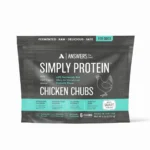
1 food in our catalog lists it, highest on the label first.
Sources
What we read
Checked October 1, 2026.
- 1 Whey
- 2 Dry Whey
- 3 Whey Protein Concentrate
- 4 Whey: A Valuable Technological Resource for the Production of New Functional Products with Added Health-Promoting Properties
- 5 Effects of dietary supplementation with increasing doses of lactose on faecal bacterial populations and metabolites and apparent total tract digestibility in adult dogs
- 6 Critically appraised topic on adverse food reactions of companion animals (2): common food allergen sources in dogs and cats
- 7 IgE reactivity to milk components in dogs with cutaneous adverse food reactions
- 8 PSX-8 Effect of Feeding Additional Whey Protein to Senior Labrador Retrievers for Maintaining Lean Mass and Minimizing Inflammation
- 9 Methods and compositions for enhancing palatability of pet food (US6254920B1)
- 10 Animal Food Labeling and Pet Food Claims