
Ingredient file // Other
Lactobacillus Casei
A real probiotic, sold on thin dog evidence
A lactic acid bacterium, grown in tanks and freeze-dried, that brands add so the bag can say probiotic. Whether enough of it arrives alive, and whether it changes anything for a healthy dog, is unproven.
Role in the food Mostly filler- What it is
- A lactic acid bacterium, the kind used in cheese and fermented milk, added as a freeze-dried live culture.
- Made from
- Bacteria grown in broth, then freeze-dried
- Main job
- Live culture for a probiotic claim
- Typical amount
- Not published; tested probiotic foods held up to 180,000 CFU/g
- Watch for
- A probiotic claim with no guaranteed live count
- Not the same as
- L. paracasei or L. rhamnosus
Straight answer
Is Lactobacillus Casei safe for dogs?
Treat it as a bonus, not a reason to buy
It sits near the end of the list because a dose of bacteria weighs almost nothing, so its position tells you nothing. Look for a guaranteed live count in CFU with a date. Without one, assume it adds a label word, not a working dose, and choose the food on its other ingredients.
- Why it is in the food
- Live culture for a probiotic claim
- Watch for
- Dogs with weak immune systems
- How common
- Listed by 8 of the 3,204 foods we track
Our read // In our catalog
In 1 of every 401 foods we track
Share of foods that list it
<1%
8 of the 3,204 foods with an ingredient list on file, from 1 brand. All freeze-dried dog food.
Each square is 1% of the catalog
Where it sits on the label
Median position 24. In the top five of 0 foods, so it is usually a minor ingredient.
Who leans on it
100%
of the foods that list it are from Tucker's. 1 brand use it in total.
What it is
How it is made
Unlike most dog food ingredients, it is not a leftover from another industry. Culture makers grow a chosen strain on purpose, harvest the cells and freeze-dry them with a protectant so some survive storage.6,7
- 01 // Source Starter strain A named strain is grown in nutrient broth. A lab run with L. paracasei, sold as casei 431, used 37°C for 18 hours.
- 02 // Process Spun down Cells are collected by centrifuge and washed twice in sterile saline to strip away the broth.
- 03 // Process Freeze-dried Frozen at minus 80°C and dried under vacuum. In the casei 431 test, 9.6% survived without a protectant, 67.1% with one.
- 04 // Output Culture powder One commercial L. casei powder is about one-third cells and two-thirds carrier, with at least 80 billion CFU per gram.
What is in it
Composition, as fed
33
% bacteria
About a third of one commercial L. casei powder is freeze-dried cells; the rest is carrier. It is a dose of microbes, not a nutrient source.
What matters is how many cells are alive, and that varies most. In L. paracasei sold as casei 431, freeze-drying survival ran 9.6% to 67.1% by protectant, and half the cells died in 30 days at 25°C.7
Why it is in the bag
Mostly there for the probiotic claim on the bag
- Main nutrition
- Supporting nutrient
- Does a job
- Mostly filler
Brands add it so the bag can say probiotic. It adds no real nutrient, and its dose is counted in live cells, not grams. Tested probiotic pet foods held 0 to 180,000 CFU per gram, while the one dog trial fed a powder at 2 billion CFU per gram, 2 to 10 g a day. Without a guaranteed live count, the culture in a food is likely far below a trial dose.1,4,9
-
01
Puts probiotic on the bag
A named culture lets a brand market live microbes. FDA treats products sold as containing live microbes as direct-fed microbials, and disease claims would turn them into drugs.9
-
02
Shifts some fecal bacteria
In a 90-dog trial of a three-strain mix with L. casei, effects varied by age group: Faecalibacterium rose only in elderly dogs, and E. coli fell only in training dogs.4
-
03
Fits freeze-dried foods
The culture is sold freeze-dried, so it suits an uncooked, freeze-dried food. Viability still falls: L. paracasei sold as casei 431 lost half its live cells in 30 days at 25°C.7
How much The one healthy-dog trial with L. casei fed a three-strain powder holding 2 billion CFU per gram, 2 to 10 g a day, mixed into food.4
Our read // The claims
What the evidence supports
Strong: controlled studies in dogs agree. Some: small or mixed dog data. Thin: mechanism or lab work only. None: nothing, or the evidence points the other way.
-
Brands say
Supports a healthy balance of gut bacteria
Outruns the evidence
Evidence
- Strong
- Some
- Thin
- None
The only dog evidence is one 90-dog trial of a three-strain mix with L. casei Zhang. Shifts appeared only in single subgroups: Faecalibacterium in elderly dogs, E. coli in training dogs. No blinding was described, and a shifted count is not a healthier dog.4
-
Owners say
Firms the stool and settles diarrhea
Outruns the evidence
Evidence
- Strong
- Some
- Thin
- None
A 2019 review of 17 dog trials found a very limited, possibly clinically unimportant effect on acute gut disease and no added benefit over diet in chronic cases. Its only L. casei product was an 8-strain mix.3
-
Brands say
Strengthens a dog's immune system
Outruns the evidence
Evidence
- Strong
- Some
- Thin
- None
The 90-dog trial saw higher serum IgG and fecal SIgA, with no blinding described. An open-label trial gave 10 dogs with bowel disease an 8-strain mix and counted regulatory T cells. Markers moved; nobody measured fewer illnesses.4,5
-
Brands say
The bacteria on the label are alive in the bag
Outruns the evidence
Evidence
- Strong
- Some
- Thin
- None
Of 19 pet foods sold as containing probiotics, none held every listed organizm, 5 grew nothing relevant, and counts ran from 0 to 180,000 CFU per gram. Species named on labels often went unfound.1
Straight answers
What owners ask
-
Q01
Is it safe for a healthy dog?
YesEFSA treats the species as presumed safe for the animals that eat it, and its tested feed culture carried only trace heavy metals. The real exception is a dog with a weakened immune system, covered below.6
-
Q02
Why is it so low on the list?
Tiny by weightBacteria are dosed in billions, not grams. One commercial powder packs at least 80 billion CFU into a gram, so a full dose weighs almost nothing. Its position says nothing about whether it works.6
-
Q03
Is it the same as L. paracasei?
Close, not sameIn 2020 taxonomists carved 23 new genera out of Lactobacillus, and this species became Lacticaseibacillus casei. Some strains sold as casei, such as casei 431, are classed as paracasei, and effects belong to the strain.3,7,8
-
Q04
Would a probiotic supplement work better?
Not reliablySupplements miss their labels too. Of 25 veterinary probiotics tested, only 2 had both an accurate label and live counts that met the claim. Pick one with a named strain and dog trial data.2
Who uses it
Brands, best sellers and the company it keeps
Top brands, by foods that list it
Foods that list it / all the brand's recipes we track.
Usually listed with, share of the foods that list it
- Pumpkin 100%
- Mixed Tocopherols 100%
- Rosemary Extract 100%
- Taurine 100%
- Zinc Amino Acid Complex 100%
- Vitamin E 88%
- Pork 50%
- Pork Marrow And Bone 50%
- Beef Heart 38%
- Calcium Carbonate 38%
- Beef 25%
- Beef Bone And Marrow 25%
On the shelf
Foods that list Lactobacillus Casei
8 foods in our catalog list it, highest on the label first.
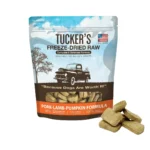 Tucker'sTucker’s Pork-Lamb-Pumpkin Diet Freeze-Dried Dog Food
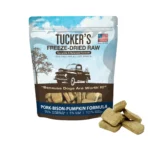 Tucker'sTucker’s Pork-Bison-Pumpkin Diet Freeze-Dried Dog Food
Show 6 more
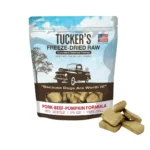 Tucker'sTucker’s Pork-Beef-Pumpkin Diet Freeze-Dried Dog Food
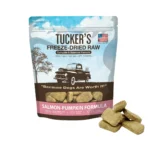 Tucker'sTucker’s Salmon-Pumpkin Diet Freeze-Dried Dog Food
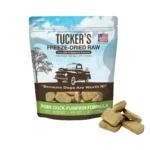 Tucker'sTucker’s Pork-Duck-Pumpkin Diet Freeze-Dried Dog Food
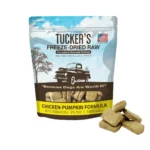 Tucker'sTucker’s Chicken-Pumpkin Diet Freeze-Dried Dog Food
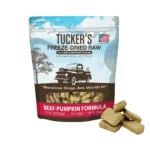 Tucker'sTucker’s Beef-Pumpkin Diet Freeze-Dried Dog Food
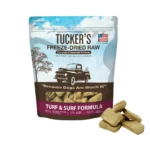 Tucker'sTucker’s Turf & Surf Diet Freeze-Dried Dog Food
Sources
What we read
Checked October 1, 2026.
- 1 Bacteriological evaluation of commercial canine and feline diets labeled as containing probiotics
- 2 Assessment of commercial probiotic bacterial contents and label accuracy
- 3 Clinical effect of probiotics in prevention or treatment of gastrointestinal disease in dogs: A systematic review
- 4 Oral Administration of Compound Probiotics Improved Canine Feed Intake, Weight Gain, Immunity and Intestinal Microbiota
- 5 Comparison of Microbiological, Histological, and Immunomodulatory Parameters in Response to Treatment with Either Combination Therapy with Prednisone and Metronidazole or Probiotic VSL#3 Strains in Dogs with Idiopathic Inflammatory Bowel Disease
- 6 Safety and efficacy of Lactobacillus casei DSM 28872 as a silage additive for all animal species
- 7 Cryoprotective effect of turanose on lyophilized Lactobacillus paracasei subsp. paracasei, L. casei 431
- 8 Lacticaseibacillus casei (Orla-Jensen 1916) Zheng et al. 2020
- 9 CPG Sec. 689.100 Direct-Fed Microbial Products
- 10 Probiotic Lactobacilli Precautions