
Ingredient file // Other
Lactobacillus Acidophilus
A real probiotic, rarely proven alive in the bag
This is a gut bacterium grown in vats, freeze-dried to a powder and added to dog food as a probiotic. Fed alive, it passes through the dog and shifts fecal bacteria while fed. No dog trial shows healthier dogs.
Role in the food Does a job- What it is
- A lactic acid bacterium, grown in fermenters and dried to a powder, added to food as a live probiotic.
- Made from
- Bacterial cultures grown in fermentation tanks
- Main job
- Live probiotic, and a label claim
- Typical amount
- Over 1 billion live cells a day in dog trials
- Watch for
- No proof the cells are still alive
- Not the same as
- L. acidophilus fermentation product
Straight answer
Is Lactobacillus Acidophilus safe for dogs?
Count it as a bonus, never the reason
It belongs near the end of the list with the vitamins, and it says nothing about the recipe above it. Judge the food on that. If a probiotic matters for your dog, choose a product with a named strain and a count guaranteed through the expiry date.
- Why it is in the food
- Live probiotic, and a label claim
- How common
- Listed by 8 of the 3,204 foods we track
Our read // In our catalog
In 1 of every 401 foods we track
Share of foods that list it
<1%
8 of the 3,204 foods with an ingredient list on file, from 1 brand. All freeze-dried dog food.
Each square is 1% of the catalog
Where it sits on the label
Median position 23. In the top five of 0 foods, so it is usually a minor ingredient.
Who leans on it
100%
of the foods that list it are from Tucker's. 1 brand use it in total.
What it is
How it is made
Culture makers grow the strain in fermenters, then dry it into a powder that pet food plants buy. Heat above 45°C harms these bacteria, so the powder must dodge cooking heat to arrive alive.6,7
- 01 // Source Starter culture One named strain is grown in nutrient broth. Lactic acid bacteria grow best between 30 and 42°C.
- 02 // Process Harvested and protected Cells are separated from the broth and mixed with cryoprotectants such as sugars, proteins or amino acids.
- 03 // Process Freeze-dried The culture is frozen, then dried by sublimation and a final drying stage, which spares more cells than heat.
- 04 // Output Probiotic powder A dry powder sold by colony forming units per gram, mixed into food in a way that avoids cooking heat.
What is in it
Composition, as fed
53
% matched
Share of 19 probiotic pet foods where a lab grew at least one listed organizm. None held everything its label named.
Why it is in the bag
A probiotic job, if the cells survive
- Main nutrition
- Supporting nutrient
- Does a job
- Mostly filler
Makers add it to deliver live bacteria and to print probiotic on the bag. Fed alive, one strain raised fecal lactobacilli and cut clostridia in dogs, then vanished 2 weeks after feeding stopped. It sits near the end of the list, so it adds no nutrition. Its job is to arrive alive, and a retail survey found no food held every organizm its label named.1,2
-
01
Seeds lactic acid bacteria
Fed alive, the strain rode through the gut of 15 dogs, raised fecal lactobacilli and cut clostridia. It vanished from feces 2 weeks after feeding stopped.1
-
02
Sells the probiotic label
Owners look for the word probiotic. In a 2003 survey, 12 of 19 foods listed only fermentation products yet still printed probiotic on the package.2
-
03
Freeze-drying keeps it alive
Heat above 45°C harms these bacteria. Freeze-drying is a common way to preserve the cultures, and freeze-dried foods skip cooking heat, making them a natural home and kibble a harder one.6,7
How much Dog trials fed over 1 billion live cells a day, and one tested kibble still held 63 to 71% of its added bacteria.1,3
Our read // The claims
What the evidence supports
Strong: controlled studies in dogs agree. Some: small or mixed dog data. Thin: mechanism or lab work only. None: nothing, or the evidence points the other way.
-
Brands say
Survives the gut and colonizes the colon
Outruns the evidence
Evidence
- Strong
- Some
- Thin
- None
In a 15-dog trial the strain survived the kibble and showed up in feces while it was fed. Two weeks after feeding stopped it was gone, so it passes through rather than settles in.1
-
Brands say
Strengthens your dog's immune system
Outruns the evidence
Evidence
- Strong
- Some
- Thin
- None
One 15-dog study, fed control, probiotic, then control again with no parallel group, saw blood counts and IgG rise. A 2016 review called the changes of questionable clinical relevance. No study measured illness.1,5
-
Owners say
Helps dogs with chronic diarrhea
Outruns the evidence
Evidence
- Strong
- Some
- Thin
- None
In a placebo-controlled trial of 21 dogs with food-responsive diarrhea, an L. acidophilus and L. johnsonii cocktail did no better than the elimination diet alone. All dogs improved on the diet.4,5
Straight answers
What owners ask
-
Q01
Is it just filler?
No, too smallFiller means bulk, and a daily dose of this weighs a fraction of a gram. Its only job is to arrive alive. When it fails, it is decoration, not filler.1,6
-
Q02
Does it survive in kibble?
SometimesOne kibble made for a Waltham trial kept 63 to 71% of its bacteria through storage. In a survey of 19 retail foods, 5 grew nothing relevant. The label cannot tell you which you have.1,2
-
Q03
Is freeze-dried food a better carrier?
Likely, unprovenFreeze-drying is one common way to preserve probiotic powders, and a freeze-dried food skips the cooking heat that harms these bacteria above 45°C. The edge is reasoned, not measured: the one dog food survival test we cite used kibble.1,6,7
-
Q04
What does fermentation product mean?
Maybe deadIt names the dried output of a fermentation, which need not hold live cells. In the 2003 survey, 12 of 19 foods listed only fermentation products yet printed probiotic on the package.2
Who uses it
Brands, best sellers and the company it keeps
Top brands, by foods that list it
Foods that list it / all the brand's recipes we track.
Usually listed with, share of the foods that list it
- Pumpkin 100%
- Mixed Tocopherols 100%
- Rosemary Extract 100%
- Taurine 100%
- Zinc Amino Acid Complex 100%
- Vitamin E 88%
- Pork 50%
- Pork Marrow And Bone 50%
- Beef Heart 38%
- Calcium Carbonate 38%
- Beef 25%
- Beef Bone And Marrow 25%
On the shelf
Foods that list Lactobacillus Acidophilus
8 foods in our catalog list it, highest on the label first.
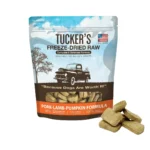 Tucker'sTucker’s Pork-Lamb-Pumpkin Diet Freeze-Dried Dog Food
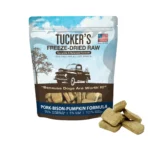 Tucker'sTucker’s Pork-Bison-Pumpkin Diet Freeze-Dried Dog Food
Show 6 more
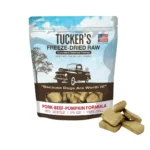 Tucker'sTucker’s Pork-Beef-Pumpkin Diet Freeze-Dried Dog Food
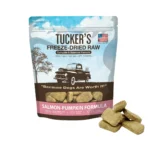 Tucker'sTucker’s Salmon-Pumpkin Diet Freeze-Dried Dog Food
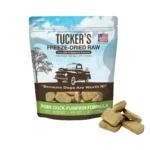 Tucker'sTucker’s Pork-Duck-Pumpkin Diet Freeze-Dried Dog Food
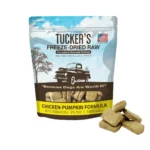 Tucker'sTucker’s Chicken-Pumpkin Diet Freeze-Dried Dog Food
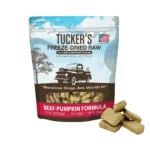 Tucker'sTucker’s Beef-Pumpkin Diet Freeze-Dried Dog Food
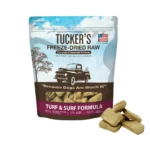 Tucker'sTucker’s Turf & Surf Diet Freeze-Dried Dog Food
Sources
What we read
Checked October 1, 2026.
- 1 Effects of probiotic Lactobacillus acidophilus strain DSM13241 in healthy adult dogs
- 2 Bacteriological evaluation of dog and cat diets that claim to contain probiotics
- 3 Fructooligosaccharides and Lactobacillus acidophilus modify gut microbial populations, total tract nutrient digestibilities and fecal protein catabolite concentrations in healthy adult dogs
- 4 Effects of probiotic bacteria in dogs with food responsive diarrhoea treated with an elimination diet
- 5 Understanding the canine intestinal microbiota and its modification by pro-, pre- and synbiotics - what is the evidence?
- 6 Current Trends in the Production of Probiotic Formulations
- 7 Factors affecting the viability of probiotics in various food products: a review of current knowledge
- 8 Get the Facts! Raw Pet Food Diets can be Dangerous to You and Your Pet
- 9 Probiotic Lactobacilli Precautions