
Ingredient file // Flavor
Filet Mignon Flavor
A taste cue for the dog, not steak
Filet mignon flavor is a flavoring, most often built on a digest of animal tissue, added in small amounts so a food smells and tastes meaty. It gets the bowl eaten. It adds almost no nutrition and no tenderloin.
Role in the food Does a job- What it is
- A flavoring added so a food tastes beefy. The label does not have to say what it is made from.
- Made from
- Not disclosed; palatants are usually digested animal tissue
- Main job
- Smell and taste appeal
- Typical amount
- Palatants run about 0.5 to 3% of a food
- Watch for
- Dogs with beef allergy; source tissue is undisclosed
- Not the same as
- Filet mignon or beef tenderloin
Straight answer
Is Filet Mignon Flavor safe for dogs?
Read past the name to the meat
Filet mignon flavor sits near the end of the list, among the salts and supplements, and tells you how the food tastes, not what it feeds. Judge the food by the first few ingredients and the analysis. If the meats up top are chicken, it is a chicken food with a beef taste.
- Why it is in the food
- Smell and taste appeal
- How common
- Listed by 9 of the 3,204 foods we track
Our read // In our catalog
In 1 of every 356 foods we track
Share of foods that list it
<1%
9 of the 3,204 foods with an ingredient list on file, from 4 brands. 8 wet dog food, 1 dry dog food.
Each square is 1% of the catalog
Where it sits on the label
Median position 16. In the top five of 0 foods, so it is usually a minor ingredient.
Above the salt
Usually listed after the salt, which caps it at roughly 1% of the recipe in 86% of foods.
Price per lb
Median of the cheapest bag price across 1 priced foods, 49% below the catalog. The price is the food's, not the ingredient's.
Who leans on it
44%
of the foods that list it are from Cesar. 4 brands use it in total.
What it is
How it is made
Makers do not publish flavor recipes. Meaty pet food flavors are mostly animal digests: organ tissue broken down with enzymes or acid, then heated to build roasted, meaty notes.5
- 01 // Source Beef organs Beef digests start from clean, unrendered parts such as lungs, spleen, kidneys, liver, blood and intestines.
- 02 // Process Enzyme hydrolysis Proteases and lipases break the proteins and fats down into small peptides, amino acids and fatty acids.
- 03 // Process Heated for flavor Heating sugars with amino acids drives the Maillard reaction, which forms pyrazines and furans, the roasted meat notes.
- 04 // Output Liquid or powder Shipped as a powder, dosed at 0.5 to 2% of a food, or a liquid at 1 to 3%.
What is in it
Composition, as fed
55
% protein
A supplier's minimum protein for beef liver digest powder, the closest published example. At a dose of a few percent, it adds little to the food.
Why it is in the bag
There to make the food taste meaty
- Main nutrition
- Supporting nutrient
- Does a job
- Mostly filler
Makers add it so dogs eat the food and owners buy it again, since a nutritious food that goes uneaten fails. Flavors like this are most often animal digests, dosed at about 0.5 to 3% of a food. Labels run by weight, and this one usually sits low on the list, so it likely adds too little protein or fat to change the food's nutrition. That is not filler: its job is smell and taste.1,5
-
01
Gets the bowl eaten
Animal digests give pet food its raw, meaty smell and taste. A food dogs refuse fails however good its nutrition, and owners stop buying it.5
-
02
Puts a meat on the front
Under the flavor rule the named flavor only has to be detectable, with no minimum percentage. A beef flavor means beef under 3%, while a beef dinner needs at least 10%.2,3
-
03
Works at a small dose
Palatant powders go in at 0.5 to 2% and liquids at 1 to 3%, so a small addition changes how the whole food smells and tastes to the dog.5
How much Commercial palatants are usually added at 0.5 to 2% as dry powders or 1 to 3% as liquids.5
Our read // The claims
What the evidence supports
Strong: controlled studies in dogs agree. Some: small or mixed dog data. Thin: mechanism or lab work only. None: nothing, or the evidence points the other way.
-
Brands say
The flavor makes the food more appealing to dogs
Evidence
- Strong
- Some
- Thin
- None
Animal digests are the main palatant in pet food, and the standard two-bowl test, now usually 20 dogs over 2 to 4 days, measures which bowl dogs prefer. No published test isolates a filet mignon flavor, and short tests miss flavor fatigue.5,6
-
Brands say
Dogs love the taste of steak
Outruns the evidence
Evidence
- Strong
- Some
- Thin
- None
Preference studies summarized in a 2021 review rank beef first for dogs, then lamb, then chicken. Nothing shows a dog can tell tenderloin from liver or lung. The cut in the name speaks to the owner.5
-
Critics say
Flavors are there to hide cheap ingredients
Outruns the evidence
Evidence
- Strong
- Some
- Thin
- None
Flavors do steer which bowl a dog picks, and a two-bowl test measures preference, not nutrition. No study shows a flavor masking a poor food. The rest of the ingredient list and the analysis tell you that.6
-
Owners say
There is real filet mignon in the food
Outruns the evidence
Evidence
- Strong
- Some
- Thin
- None
A beef flavor claim means beef under 3% of the product, and no cut is required. Beef digests come from organs such as lung, spleen and liver. One filet mignon flavor food lists chicken and chicken liver ahead of beef.2,5,9
-
Owners say
Natural flavor means barely processed
Outruns the evidence
Evidence
- Strong
- Some
- Thin
- None
AAFCO's natural standard allows rendering, hydrolysis and enzyme digestion, so an enzyme-made digest qualifies. A natural flavor claim covers only the flavor, and FDA has not defined natural for pet food at all.4
Straight answers
What owners ask
-
Q01
Is there any filet mignon in it?
Not requiredThe flavor rule asks only that the flavor be detectable, under 3% for a beef flavor claim, and says nothing about the cut. Meaty palatants are usually digests of organs like liver and lung.2,5
-
Q02
Is it just filler?
No, it's flavorAt 0.5 to 3% of a food it is far too small to fill anything. It has one job, smell and taste, and a food a dog will not eat delivers no nutrition at all.5
-
Q03
Why is it listed among the vitamins?
Tiny doseLabels run by weight, and flavors work at a few percent or less. In one filet mignon flavor food it sits between DL-methionine and guar gum, deep in the trace section.1,9
-
Q04
Can my beef-allergic dog eat it?
Avoid itBeef is the most commonly recognized food allergen in dogs, and the label does not name the species or tissue behind the flavor. Assume a filet mignon flavor carries beef.7
Who uses it
Brands, best sellers and the company it keeps
Top brands, by foods that list it
Foods that list it / all the brand's recipes we track.
Amazon best sellers that list it
Rank on Amazon's dog food best seller list, checked October 2026.
Usually listed with, share of the foods that list it
- Beef 100%
- Chicken 67%
- Water 56%
- Chicken Liver 44%
- Meat By-Products 44%
- Wheat Gluten 44%
- Wheat Flour 44%
- Sufficient Water For Processing 33%
- Animal Plasma 33%
- Corn Starch 33%
- Chicken Heart 33%
- Potatoes 22%
On the shelf
Foods that list Filet Mignon Flavor
9 foods in our catalog list it, highest on the label first.
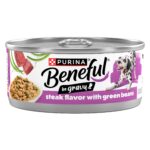 PurinaPurina Beneful Steak & Green Beans in Gravy Wet Dog Food
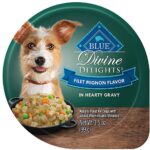 BlueBlue Delights Filet Mignon Hearty Gravy Wet Dog Food
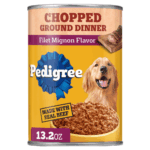 PedigreePedigree Chopped Ground Dinner Adult Can, Filet Mignon Wet Dog Food
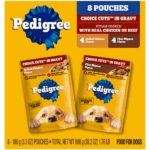
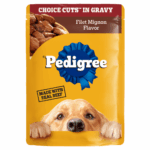 PedigreePedigree Choice Cuts IN Gravy Adult Pouch, Filet Mignon Wet Dog Food
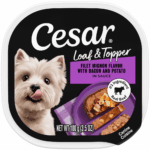
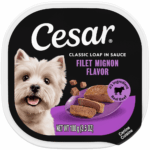 CesarCesar Classic Loaf in Sauce Filet Mignon Wet Dog Food
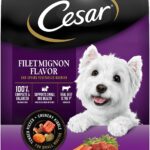 CesarCesar Filet Mignon Flavor & Spring Vegetables Garnish Dry Dog Food
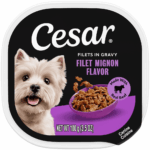
On labels as
Natural filet mignon flavor: what changes
One page covers every name. Here is what each label word adds, and whether it changes anything for your dog.
Natural filet mignon flavor
Matters for your dog A little
Natural Filet Mignon Flavor
What it means AAFCO defines natural: from plant, animal or mined sources, with processing such as heating, rendering, hydrolysis or enzyme digestion allowed, and no chemically synthetic additives or processing aids beyond trace amounts. On this label it covers only the flavor. FDA has not defined natural for pet food.
For your dog The flavor cannot be built from synthetic flavor chemicals, a real difference in what is in the bag. An enzyme digest of organ tissue still qualifies, and the word says nothing about the rest of the food. We found no study showing natural flavors change a dog's health.4,5
- Strong
- Some
- Thin
- None
Sources
What we read
Checked October 1, 2026.
- 1 Reading Labels
- 2 Dog and Cat Foods
- 3 A Consumer's Guide: Overview of Pet Food Labels
- 4 Natural
- 5 Dry Pet Food Flavor Enhancers and Their Impact on Palatability: A Review
- 6 Pet Food Palatability Evaluation: A Review of Standard Assay Techniques and Interpretation of Results with a Primary Focus on Limitations
- 7 Critically appraised topic on adverse food reactions of companion animals (2): common food allergen sources in dogs and cats
- 8 Beef Liver Powder for Pet Food as Super Palatability Enhancer - Beef Liver Hydrolysate and Beef Liver Digest
- 9 Cesar Filets in Gravy Adult Wet Dog Food Variety Pack - Filet Mignon & New York Strip, 12 Count