
Ingredient file // Fruit or vegetable
Alfalfa Sprouts
A small green addition, not a vitamin plan
Alfalfa sprouts are young shoots grown from alfalfa seeds. They add some plant material to kibble, but no dog study shows that the amount in a recipe improves stool, digestion or immune health.
Role in the food Mostly filler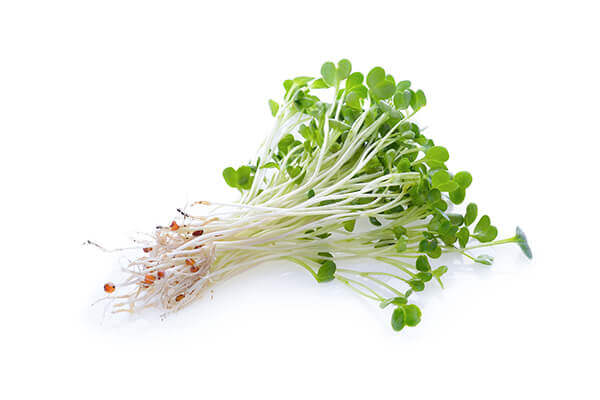
- What it is
- Young shoots grown from germinated alfalfa seeds and harvested before the plants mature.
- Made from
- Germinated alfalfa seeds
- Main job
- Minor green ingredient
- Typical amount
- Not published
- Watch for
- Bacteria on sprouts served raw
- Not the same as
- Alfalfa meal
Straight answer
Is Alfalfa Sprouts safe for dogs?
Read the bigger ingredients first
If alfalfa sprouts sit among the minor ingredients, give them little credit for the food's nutrition. Fresh sprouts carry substantial water, and the bag does not state their amount. Check the main protein sources and the nutritional adequacy statement before accepting a vitamin, fiber or immune claim.
- Why it is in the food
- Minor green ingredient
- Watch for
- Bacteria on raw sprouts
- How common
- Listed by 2 of the 3,204 foods we track
Our read // In our catalog
In 1 of every 1,602 foods we track
Share of foods that list it
<1%
2 of the 3,204 foods with an ingredient list on file, from 1 brand. All dry dog food.
Each square is 1% of the catalog
Where it sits on the label
Median position 22.5. In the top five of 0 foods, so it is usually a minor ingredient.
Above the salt
Almost always listed before the salt, so there is more of it than a pinch.
Price per lb
Median of the cheapest bag price across 2 priced foods, 14% above the catalog. The price is the food's, not the ingredient's.
Who leans on it
100%
of the foods that list it are from Fromm. 1 brand use it in total.
The story
How seed outbreaks and a monkey study shaped alfalfa sprouts
Pet food brands such as Fromm list alfalfa sprouts for their zinc, iron and vitamins, but most of the public record on this ingredient is about human food safety. In 1995, sprouts grown from contaminated seed caused at least 242 Salmonella infections in at least 17 US states and Finland. Investigators traced the sprouts to seed from one Dutch shipper, a new way for fresh produce to spread illness across borders.7,10
That outbreak and others in the mid-1990s led FDA to publish guidelines for sprout growers in 1999. They did not end the problem. From 1998 through 2010, 33 sprout outbreaks sickened 1,330 people in the US, and in 15 of the 18 with records, growers had not followed key FDA steps. Seed chlorination cut bacteria but did not remove the risk. In November 2015, FDA published sprout requirements as part of its Produce Safety Rule.5,11
A second turning point came from the lab. In 1982, researchers reported that cynomolgus monkeys fed alfalfa sprouts developed blood abnormalities resembling human lupus, and that L-canavanine, an amino acid in the sprouts, brought the syndrome back. Two years later, the same group fed monkeys autoclaved alfalfa seeds for up to 1 year and saw no such signs. Kibble is cooked too, but we found no study that measured canavanine in finished dog food.9,12,13
What it is
How it is made
Sprout growers raise alfalfa seeds for harvest as young shoots. This is a purpose-grown crop, not a processing leftover. Its high water content makes fresh sprouts perishable before they reach a food maker.1,3,5,6
- 01 // Source Alfalfa seeds Growers start with seeds intended for sprouting and check the seed supply for food safety hazards.
- 02 // Process Soaked Water softens the seed hull and starts germination; growers may soak seeds before moving them into growing units.
- 03 // Process Grown and harvested Seeds grow into young shoots under moist conditions and are harvested before becoming mature alfalfa plants.
- 04 // Output Fresh sprouts The harvested shoots supply the named ingredient; an ingredient list does not disclose their recipe percentage.
What is in it
Composition, dry matter
42.8
% protein
Protein in one laboratory sprout sample after removing its water. Fresh sprouts are mostly water, so this is not their protein content as added.
Benefits
What it does for your dog
Each benefit carries the same evidence grade as the claims below.
-
01
Adds a little plant protein
Dried sprouts test at about 43% protein, but fresh ones are about 91% water, so a minor listing adds a small share of a food's protein. No dog trial has measured it.1,3
- Strong
- Some
- Thin
- None
-
02
Supplies potassium and other minerals
One dried alfalfa sprout sample held 1.31 g potassium per 100 g, along with zinc and iron. Dogs need these minerals, but that is the only support, and the sprout share is undisclosed.1,6
- Strong
- Some
- Thin
- None
-
03
Lean weight, tested only with barley sprouts
In a 16 week beagle trial, a diet with 2.8% barley sprouts trimmed body weight by 7.2%. No one has run that test with alfalfa sprouts, so there is no evidence for this ingredient.14
- Strong
- Some
- Thin
- None
Why it is in the bag
Mostly a green on the label, at this amount
- Main nutrition
- Supporting nutrient
- Does a job
- Mostly filler
Alfalfa sprouts tend to appear among a food's minor ingredients, and lists run by weight, heaviest first. Fresh sprouts are mostly water, so a minor listing likely adds too little to change the food's protein, fiber or minerals, even though dried sprouts carry real protein and fiber per gram. The likely reason they are there is a recognizable green on the label, which one brand sells as immune support.1,3,6,7
-
01
Adds some plant fiber
The sprouted seed contains fiber, but the label gives no amount. A minor listing does not show that enough was added to change a dog's stool.1,6
-
02
Gives the label greens
A pet food brand promotes the sprouts' vitamins and plant compounds as immune support. That makes the ingredient easy to recognize, though the claim has no dog outcome behind it.7
-
03
Fits a small role
Fresh sprouts are about 91% water, so each pound adds little dry nutrition. In a recipe they play a minor part, not a main source of protein or fiber.3
How much A typical recipe percentage is not published; the ingredient list gives incoming weight order, not the amount of sprouts.6
Our read // The claims
What the evidence supports
Strong: controlled studies in dogs agree. Some: small or mixed dog data. Thin: mechanism or lab work only. None: nothing, or the evidence points the other way.
-
Brands say
Sprouts are a valuable source of essential fiber
Outruns the evidence
Evidence
- Strong
- Some
- Thin
- None
One dried laboratory sample held 14% crude fiber, but USDA puts fresh sprouts at 91% water. No dog study has fed sprouts as a fiber source, and the bag does not say how much is in it.1,3,8
-
Brands say
Sprouts support a dog's immune system
Outruns the evidence
Evidence
- Strong
- Some
- Thin
- None
A brand links sprout micronutrients to immune support. A laboratory comparison measured nutrients and plant compounds in seeds and sprouts; it tested no immune outcome in dogs or finished kibble.1,7
-
Brands say
Sprouts supply enzymes along with vitamins and minerals
Outruns the evidence
Evidence
- Strong
- Some
- Thin
- None
A brand lists enzymes among what sprouts provide. Dry kibble is cooked in an extruder, and no study has measured active sprout enzymes in finished food or any effect from them in dogs.8,9
The research
Studies worth knowing
Published research we read for this page, dog studies first.
-
2025 // Feeding trial, 2 foods
Barley sprouts trimmed weight in beagles over 16 weeks14
14 adult beagles, 7 per diet; barley sprouts, not alfalfa
Found. Dogs fed a diet with 2.8% barley sprouts ended at about 92.8% of their starting weight, a 7.2% loss. Both diets had the same calories, and blood values stayed within reference ranges.
What it means. This is the closest dog sprout trial. It used a different plant and only 14 dogs, so it says nothing direct about alfalfa sprouts.
-
1984 // Feeding trial, cooked seeds
Cooked alfalfa seeds caused no lupus signs in monkeys13
Cynomolgus monkeys; no dog study exists
Found. Monkeys ate autoclaved alfalfa seeds for up to 1 year and showed no blood signs of the lupus resembling illness that raw seeds and sprouts had caused in earlier monkeys.
What it means. Heat appears to remove the raw seed's lupus resembling effect in primates. Kibble is cooked, but no one has tested this in dogs or finished pet food.
-
2014 // Review of outbreak records
Sprout growers skipped FDA steps in 15 of 18 documented outbreaks11
US sprout outbreaks, 1998 to 2010; human illness
Found. Investigators counted 33 US sprout outbreaks affecting 1,330 people. Of 18 outbreaks with grower records, 15 involved skipped FDA guidelines, while 3 came from firms that appeared to follow them. Seed chlorination reduced but did not end the risk.
What it means. Even firms that appeared to follow FDA guidelines produced outbreak sprouts, so raw sprouts carry some infection risk from any grower.
Straight answers
What owners ask
-
Q01
Is it just filler?
Yes, in partSprouts contain plant nutrients, so they are not empty. Their amount is undisclosed, and no dog feeding result shows a benefit at the amount used. Treat a minor listing chiefly as a recognizable green on the label.1,6
-
Q02
Are raw sprouts safe?
Use cautionRaw sprouts have been linked to foodborne illness outbreaks. FDA links a 2026 outbreak to a recalled alfalfa seed lot, while its investigation remains open. Keep recalled sprouts out of your dog's bowl.4,5
Who uses it
Brands, best sellers and the company it keeps
Top brands, by foods that list it
Foods that list it / all the brand's recipes we track.
On the shelf
Foods that list Alfalfa Sprouts
2 foods in our catalog list it, highest on the label first.
On labels as
Other names for this
Manufacturers do not all use the same wording. These all mean the same thing.
Sources
What we read
Checked October 1, 2026.
- 1 Small-Seeded Legumes as a Novel Food Source. Variation of Nutritional, Mineral and Phytochemical Profiles in the Chain: Raw Seeds-Sprouted Seeds-Microgreens
- 2 GERMINATION AND NUTRIENT COMPOSITION OF ALFALFA SEEDS
- 3 Nutritive Value of Foods
- 4 Outbreak Investigation of Shiga Toxin-producing E. coli & Salmonella: Sprouts (August 2026)
- 5 Guidance for Industry: Standards for the Growing, Harvesting, Packing, and Holding of Sprouts for Human Consumption
- 6 What's in the Ingredients List?
- 7 Alfalfa Sprouts
- 8 STAMINA, 10KG
- 9 How Pet Food Is Made
- 10 An international outbreak of Salmonella infections caused by alfalfa sprouts grown from contaminated seeds
- 11 Outbreaks caused by sprouts, United States, 1998-2010: lessons learned and solutions needed
- 12 Systemic lupus erythematosus-like syndrome in monkeys fed alfalfa sprouts: role of a nonprotein amino acid
- 13 Elimination of toxicity from diets containing alfalfa seeds
- 14 Anti-Obesity Potential of Barley Sprouts in Dog Diets and Their Impact on the Gut Microbiota