
Ingredient file // Animal protein
Dried Salmon
Concentrated salmon protein, not an omega-3 cure
Dried salmon is salmon flesh or filleting trimmings with the water cooked off, leaving mostly protein and fish fat. It gives a dog concentrated, good-quality animal protein and some omega-3s, but too little proof of skin benefits to buy it for that.
- What it is
- Salmon flesh, often with filleting leftovers, cooked and dried into a shelf-stable protein ingredient.
- Made from
- Farmed or wild salmon and filleting trimmings
- Main job
- Concentrated animal protein
- Typical amount
- Not published; a dog trial fed salmon meal at 10%
- Watch for
- Fish fats oxidize, so freshness and antioxidants matter
- Not the same as
- Salmon oil
Straight answer
Is Dried Salmon safe for dogs?
Count it as protein, not a skin treatment
Dried salmon high in the list means real fish protein is carrying the recipe. Check the protein on a dry matter basis and see what sits beside it, such as fish meal or peas. If your dog needs omega-3s for skin, ask the brand for a measured EPA and DHA figure, not a salmon picture.
- Why it is in the food
- Concentrated animal protein
- How common
- Listed by 4 of the 3,204 foods we track
Our read // In our catalog
In 1 of every 801 foods we track
Share of foods that list it
<1%
4 of the 3,204 foods with an ingredient list on file, from 4 brands. 3 dry dog food, 1 dog food topper.
Each square is 1% of the catalog
Where it sits on the label
Median position 6.5. In the top five of 2 foods, so it is usually a main ingredient.
Above the salt
Almost always listed before the salt, so there is more of it than a pinch.
Price per lb
Median of the cheapest bag price across 3 priced foods, 74% above the catalog. The price is the food's, not the ingredient's.
Who leans on it
25%
of the foods that list it are from Earth Animal. 4 brands use it in total.
What it is
How it is made
Salmon farms and fisheries sell fillets. About a third of a gutted salmon is left as heads, frames, skin and trimmings, and much of that goes into pet food as meal or dried salmon.4,5,6
- 01 // Source Salmon and trimmings Processing leaves about 33% of a gutted salmon as trimmings, heads, frames, skins and belly flaps.
- 02 // Process Cooked and pressed Fish meal is made by cooking, pressing, drying and milling whole fish or processing leftovers.
- 03 // Process Dried Low-temperature drying uses milder conditions. The label does not say which method a supplier used.
- 04 // Process Stabilized One salmon meal supplier adds 1,000 to 1,500 ppm of a tocopherol-based antioxidant to protect the fat.
- 05 // Output Dried salmon A dry, shelf-stable powder milled from cooked salmon; most food-grade co-products in one study went into pet food.
What is in it
Composition, dry matter
58-63
% protein
Protein in salmon flesh once the water is gone, wild at the top. Farmed fish carry nearly twice the fat, which dilutes the protein.
Why it is in the bag
What the manufacturer gets
-
01
Protein without the water
Raw salmon is about 65 to 69% water. Dried, the same flesh is 58 to 63% protein, which the finished kibble keeps instead of losing in the extruder.1,2
-
02
A market for filleting leftovers
About 33% of a gutted salmon is left after processing. In a 2025 German study, most food-grade salmon co-products went to pet food.5
-
03
A protein besides beef and chicken
Beef and chicken were behind 102 and 45 of 297 proven dog food allergies, fish behind 5. Fish gives brands a protein line away from the common triggers.7
-
04
Brings EPA and DHA
Raw farmed salmon carries about 2 g of EPA plus DHA per 100 g, roughly 5.6% of its dry weight, unless the fat is pressed out.1
How much No typical amount is published; a palatability trial fed salmon meal with crushed bones at 10% of the diet, and dogs ate it as readily as chicken.3
Our read // The claims
What the evidence supports
Strong: controlled studies in dogs agree. Some: small or mixed dog data. Thin: mechanism or lab work only. None: nothing, or the evidence points the other way.
-
Brands say
Dried salmon is a concentrated protein source
Evidence
- Strong
- Some
- Thin
- None
Plain arithmetic: raw salmon is 65 to 69% water, and dried flesh is 58 to 63% protein. Salmon meal with crushed bones scored a protein efficiency ratio of 3.5 in a chick assay, rated high quality.1,2,3
-
Brands say
Salmon is safe for dogs with food allergies
Outruns the evidence
Evidence
- Strong
- Some
- Thin
- None
Fish was behind only 5 of 297 proven dog food allergies, against 102 for beef. The review says diet history was often missing and dogs were tested against only a few allergens, so these counts cannot show true prevalence. Rare is not never.7
-
Brands say
Salmon's omega-3s calm itchy skin and shine the coat
Outruns the evidence
Evidence
- Strong
- Some
- Thin
- None
One Hill's-funded 40-dog trial tested a diet with fish oil, flax and antioxidants, not dried salmon alone. Lesion scores (CADESI-4) fell 49% by day 60 versus baseline (P = 0.0007) and beat placebo (P = 0.02), yet itching itself did not differ between diets.8
-
Owners say
Fish in dog food carries dangerous mercury
Outruns the evidence
Evidence
- Strong
- Some
- Thin
- None
FDA testing of 94 fresh and frozen salmon samples averaged 0.022 ppm mercury, among the lowest of commercial fish, while swordfish averaged 0.995 ppm. Salmon is a poor target for this worry.9
-
Owners say
Salmon can give dogs salmon poisoning
Outruns the evidence
Evidence
- Strong
- Some
- Thin
- None
The disease comes from a worm-borne bacterium in raw Pacific Northwest fish and kills up to 90% of untreated dogs. Cooking or freezing kills the worms, so cooked, dried salmon in kibble carries no such risk.10
Straight answers
What owners ask
-
Q01
Is dried salmon the same as salmon meal?
Close cousinsBoth are salmon with the water removed. Meal is pressed, so much of the fat leaves and supplier specs run 66 to 68% protein with fat under 17%. The label never says which process or which parts.4,6
-
Q02
Is salmon first better than dried salmon?
Not alwaysIngredient lists run by weight on an as-fed basis, water included. Raw salmon is 65 to 69% water that leaves in the extruder, so dried salmon further down the list can deliver more salmon protein than fresh salmon listed first.1,2,12,13
-
Q03
Does salmon make kibble tastier?
Not provenIn a palatability test, dogs ate a diet with 10% salmon meal about as readily as a chicken control, an intake ratio of 0.52. Salmon hydrolysate, a different ingredient, did win.3
Who uses it
Brands, best sellers and the company it keeps
Top brands, by foods that list it
Foods that list it / all the brand's recipes we track.
Usually listed with, share of the foods that list it
- Salmon 75%
- Flaxseed 50%
- Chickpeas 50%
- Peas 50%
- Sweet Potatoes 50%
- Quail 25%
- Duck 25%
- Quinoa 25%
- Coconut Glycerin 25%
- Dried Sweet Potatoes 25%
- Goose 25%
- Dried Carrots 25%
On the shelf
Foods that list Dried Salmon
4 foods in our catalog list it, highest on the label first.
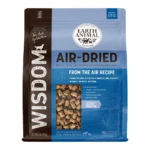 Earth AnimalEarth Animal Wisdom Air-Dried From the Air Recipe Dog Food Topper
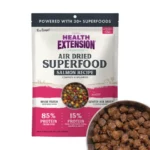 Health ExtensionHealth Extension Gently Air Dried Superfoods Salmon Recipe Dry Dog Food
 AcanaAcana Butcher’s Favorites, Wild-Caught Salmon Recipe Dry Dog Food
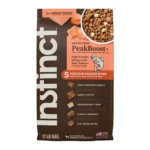 InstinctInstinct Raw Boost PeakBoost+ Kibble Real Salmon Recipe Grain-Free Dry Dog Food
Sources
What we read
Checked October 1, 2026.
- 1 Fish, raw, farmed, Atlantic, salmon: nutrition facts (USDA National Nutrient Database data)
- 2 Fish, raw, wild, Atlantic, salmon: calories and nutrition facts (USDA National Nutrient Database data)
- 3 Fish meals, fish components, and fish protein hydrolysates as potential ingredients in pet foods
- 4 Fish meal
- 5 Salmon rest raw material flow, without a trace? Assessing resource efficiency of salmon processing in Germany
- 6 Pet food ingredients
- 7 Critically appraised topic on adverse food reactions of companion animals (2): common food allergen sources in dogs and cats
- 8 Randomized, double-blind, placebo-controlled clinical trial measuring the effect of a dietetic food on dermatologic scoring and pruritus in dogs with atopic dermatitis
- 9 Mercury Levels in Commercial Fish and Shellfish (1990-2012)
- 10 Discovery of new bacteria complicates problem of salmon poisoning in dogs
- 11 Labeling and Use of Ethoxyquin in Animal Feed
- 12 What's in the Ingredients List?
- 13 Dog and Cat Foods