
Ingredient file // Animal protein
Wild-caught Pacific Salmon
Real fish protein, with benefits that need proof
Wild-caught Pacific salmon is fish from a commercial catch, supplied as flesh or usable trim for pet food. It gives dogs animal protein and marine fats. The ingredient name does not reveal the finished food's omega-3 amount or promise a skin or joint benefit.
- What it is
- Pacific salmon caught in a fishery and supplied as raw fish material for a dog food recipe.
- Made from
- Pacific salmon flesh or usable trim
- Main job
- Animal protein and marine fats
- Typical amount
- Not published
- Watch for
- Salmon allergy and exposure to raw fish
- Not the same as
- Salmon meal or salmon oil
Straight answer
Is Wild-caught Pacific Salmon safe for dogs?
Read the other proteins and check the fats
Salmon high on a kibble list supplies animal protein, but its raw water weight makes that position hard to translate into finished protein. Read the other major ingredients and ask for finished-food EPA and DHA amounts if a skin or joint claim matters to you. Wild-caught describes sourcing.
- Why it is in the food
- Animal protein and marine fats
- How common
- Listed by 3 of the 3,204 foods we track
Our read // In our catalog
In 1 of every 1,068 foods we track
Share of foods that list it
<1%
3 of the 3,204 foods with an ingredient list on file, from 1 brand. 2 wet dog food, 1 dry dog food.
Each square is 1% of the catalog
Where it sits on the label
Median position 4. In the top five of 3 foods, so it is usually a main ingredient.
Above the salt
Almost always listed before the salt, so there is more of it than a pinch.
Price per lb
Median of the cheapest bag price across 1 priced foods, about level with the catalog. The price is the food's, not the ingredient's.
Who leans on it
100%
of the foods that list it are from Open Farm. 1 brand use it in total.
What it is
How it is made
Commercial fisheries catch Pacific salmon for seafood. Cutting fish for that market leaves usable portions and trim, which processors also sell to pet food makers. Freezing moves the fish material through the supply chain.7,9
- 01 // Source Pacific salmon catch Fish are caught in Pacific fisheries and moved into a chilled or frozen seafood supply chain.
- 02 // Process Cut for seafood Processors head, gut or fillet fish, leaving usable material alongside seafood products.
- 03 // Process Frozen for shipment Fish portions and trimmings are frozen for transport to pet food manufacturers.
- 04 // Output Raw salmon material Chilled or frozen salmon enters the recipe; commercial kibble and canned foods receive heat treatment.
What is in it
Composition, dry matter
59-84
% protein
Calculated from USDA measurements of edible raw Pacific salmon after removing water. This describes sampled fish, not a supplier specification.
Why it is in the bag
What the manufacturer gets
-
01
Supplies animal protein
Salmon flesh supplies digestible protein. In a controlled dog comparison, a salmon fillet diet had similar apparent nutrient digestibility to diets using chicken, beef, pork or pollock.1
-
02
Adds marine fats
Salmon contributes EPA and DHA, but amounts differ among Pacific salmon species. Its place on an ingredient list does not disclose how much reaches the finished food.6,8
-
03
Uses seafood trim
Seafood processors sell frozen fish portions and trimmings to pet food makers. That gives manufacturers another market for usable material produced while preparing fish for people.7
How much A controlled dog study used salmon fillet to supply 25% of diet energy; that test amount is not a usual recipe percentage.1
Our read // The claims
What the evidence supports
Strong: controlled studies in dogs agree. Some: small or mixed dog data. Thin: mechanism or lab work only. None: nothing, or the evidence points the other way.
-
Brands say
Salmon supplies digestible animal protein
Evidence
- Strong
- Some
- Thin
- None
A controlled comparison fed dogs diets using 5 different meat or fish proteins, including salmon fillet, and found similar apparent nutrient digestibility. It supports salmon as useful protein but does not prove an advantage for every salmon ingredient.1
-
Brands say
Salmon in kibble eases arthritic joints
Outruns the evidence
Evidence
- Strong
- Some
- Thin
- None
A trial randomized 212 dogs to fish-oil diets of differing doses; 177 completed per protocol, with modest joint gains only at the highest dose. The diet maker funded it, and it tested measured oil, not salmon flesh in ordinary kibble.2,3,6
-
Brands say
Salmon food clears itchy skin
Outruns the evidence
Evidence
- Strong
- Some
- Thin
- None
A blinded trial in 22 dogs with atopic dermatitis found that a fish oil supplement reduced itch medicine use. The oil supplier provided the trial oils. Salmon in an ordinary food was not tested.4
-
Brands say
Wild salmon always has more omega-3 than farmed
Outruns the evidence
Evidence
- Strong
- Some
- Thin
- None
USDA samples contained 1.91 g of EPA plus DHA per 100 g of farmed Atlantic salmon and 0.69 g in wild pink salmon. These were different species, but they disprove an automatic advantage for wild fish.6
-
Brands say
Salmon is hypoallergenic for every dog
Outruns the evidence
Evidence
- Strong
- Some
- Thin
- None
A review of 297 dogs with documented food reactions found fish reactions in 5 and a reported salmon reaction in 1. Salmon may be unfamiliar to an individual dog, but it can still trigger an allergy.5
Straight answers
What owners ask
-
Q01
Is it just filler?
NoSalmon supplies animal protein and fish fat. A dog feeding study found salmon fillet digested similarly to several other animal proteins. The ingredient name cannot show how much salmon remains in the finished recipe.1,6,8
-
Q02
Does salmon first mean most protein?
Not necessarilyIngredients are ranked by weight. Raw Pacific salmon samples contained about 66 to 76% water, and much of that water leaves during kibble making, so read the other major protein ingredients too.6,8
-
Q03
Can a salmon-allergic dog eat it?
NoA dog with a documented reaction to salmon should avoid it, even if the bag also names another meat. Check the full ingredient list when choosing a replacement food.5,8
Who uses it
Brands, best sellers and the company it keeps
Top brands, by foods that list it
Foods that list it / all the brand's recipes we track.
Usually listed with, share of the foods that list it
- Flaxseed 100%
- Oats 67%
- Carrots 67%
- Ocean Whitefish 33%
- Fish Broth 33%
- Pumpkin 33%
- Barley 33%
- Tricalcium Phosphate 33%
- Agar-Agar 33%
- Salmon Broth 33%
- Garbanzo Beans 33%
- Pea Protein 33%
On the shelf
Foods that list Wild-caught Pacific Salmon
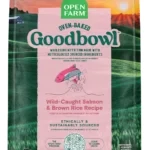
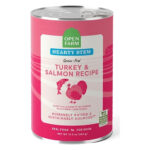
3 foods in our catalog list it, highest on the label first.

Sources
What we read
Checked October 1, 2026.
- 1 Protein digestibility evaluations of meat and fish substrates using laboratory, avian and ileally cannulated dog assays
- 2 Dose-Titration Effects of Fish Oil in Osteoarthritic Dogs
- 3 ERRATUM
- 4 A placebo-controlled, double-blind study evaluating the effect of orally administered polyunsaturated fatty acids on the oclacitinib dose for atopic dogs
- 5 Critically appraised topic on adverse food reactions of companion animals (2): common food allergen sources in dogs and cats
- 6 Nutrient content and variability in newly obtained salmon data for USDA Nutrient Database for Standard Reference
- 7 Alaska Seafood: Overview of the Global Supply Chain
- 8 What's in the Ingredients List?
- 9 Byproducts
- 10 Salmon Poisoning Disease in Dogs
- 11 Nutrient content and variability in newly obtained salmon data for USDA Nutrient Database for Standard Reference