
Ingredient file // Fat or oil
Medium Chain Triglyceride Oil
Real brain fuel at trial doses, otherwise a garnish
MCT oil is a refined fat built from the 8- and 10-carbon fatty acids in coconut and palm kernel oil. At therapeutic levels it modestly cut seizures in epileptic dogs. An ordinary kibble does not say how much it holds.
Role in the food Supporting nutrient- What it is
- A refined oil rebuilt from the 8- and 10-carbon fatty acids split out of coconut or palm kernel oil.
- Made from
- Coconut or palm kernel oil
- Main job
- Fast-burning fat for brain energy
- Typical amount
- 5.5 to 6.5% of the diet in dog trials
- Watch for
- Gas, soft stools and poor acceptance at higher doses
- Not the same as
- Coconut oil
Straight answer
Is Medium Chain Triglyceride Oil safe for dogs?
Check the dose before paying for it
Near the end of a list, beside the minerals, MCT oil is a small amount with no tested effect. On a therapeutic neurology or senior diet it should sit higher, and the maker should state the level, since trials used 5.5 to 6.5% of the diet. For an epileptic dog it adds to the drugs, never replaces them.
- Why it is in the food
- Fast-burning fat for brain energy
- How common
- Listed by 1 of the 3,204 foods we track
Our read // In our catalog
In 1 of every 3,204 foods we track
Share of foods that list it
<1%
1 of the 3,204 foods with an ingredient list on file, from 1 brand. All dry dog food.
Each square is 1% of the catalog
Where it sits on the label
Median position 4. In the top five of 1 food, so it is usually a main ingredient.
Who leans on it
100%
of the foods that list it are from Wysong. 1 brand use it in total.
What it is
How it is made
MCT oil comes out of the coconut and palm kernel oil trade. Coconut oil is only about 10 to 18% 8- and 10-carbon fatty acids, palm kernel oil 6 to 9%, so makers split the oil and keep just those.5
- 01 // Source Coconut or palm kernel Coconut oil is 46 to 54% lauric acid. Caprylic and capric acids together make up only 10 to 18%.
- 02 // Process Split The oil is hydrolyzed into free fatty acids and glycerol, freeing the medium-chain acids for collection.
- 03 // Process Rebuilt Caprylic and capric acids are esterified back onto glycerol. Chemical catalysts are the cheap route; enzymes cost more.
- 04 // Output MCT oil An oil that stays liquid at room temperature and carries about 8.4 kcal per gram, against 9 for ordinary fats.
What is in it
Composition, as fed
8.4
kcal per gram
Slightly less energy than ordinary fat at 9. It is still pure fat, so it adds calories fast, not protein or fiber.
Why it is in the bag
A real dose of brain fuel when listed high
- Main nutrition
- Supporting nutrient
- Does a job
- Mostly filler
Makers add MCT oil as a fast-burning fat that the liver turns partly into ketones, the idea behind senior brain and epilepsy diets. Ingredients are listed by weight, so MCT oil near the top of a kibble list is likely several percent of the food, possibly close to the 5.5% one epilepsy trial fed. Listed down by the minerals, it would likely be too little to change anything. No label states the level.1,3,5,10
-
01
Brain energy in senior diets
Medium-chain fatty acids travel straight to the liver through the portal vein and are burned or turned into ketones. Aged beagles fed 5.5% MCT had higher blood ketones.3,5
-
02
Add-on for epileptic dogs
Therapeutic neurology diets and supplements use it next to seizure drugs. Two placebo-controlled crossover trials found modestly fewer seizures with it.1,2
-
03
Calories on a low-fat diet
Vets use it to give calories and fatty acids to dogs whose diets must restrict ordinary fat.7
How much Dog trials fed it at 5.5 to 6.5% of the diet or as oil supplying 9 to 10% of energy; a 9% diet drew poor acceptance.1,2,3,4,6
Our read // The claims
What the evidence supports
Strong: controlled studies in dogs agree. Some: small or mixed dog data. Thin: mechanism or lab work only. None: nothing, or the evidence points the other way.
-
Vets say
MCT oil cuts seizures in epileptic dogs
Evidence
- Strong
- Some
- Thin
- None
Two placebo-controlled crossover trials, 21 and 28 drug-treated dogs, found fewer seizures on MCT: a median 2.51 against 2.67 a month in the larger. Only 10 of 21 and 5 of 28 dogs at least halved them. It is an add-on to drugs.1,2
-
Brands say
MCT fuels the brain with ketones
Outruns the evidence
Evidence
- Strong
- Some
- Thin
- None
It does raise ketones, but barely. In the 21-dog trial blood beta-hydroxybutyrate went from 0.053 to 0.071 mmol/l, a small rise rather than the deep ketosis the word ketogenic suggests.1,9
-
Brands say
Sharpens the aging dog's brain
Outruns the evidence
Evidence
- Strong
- Some
- Thin
- None
24 lab beagles on 5.5% MCT for 8 months did better on hard tasks. In an 87-dog clinical trial the control diet also improved 4 of 6 signs. Purina funded both, and both used therapeutic doses.3,4
-
Owners say
MCT oil helps dogs lose weight
Outruns the evidence
Evidence
- Strong
- Some
- Thin
- None
It carries about 8.4 kcal per gram against 9 for other fats, and human studies hint at more fat burning. The dog trials saw no meaningful weight change, and none tested it for weight loss.1,5,8
-
Owners say
Coconut oil does the same job
Outruns the evidence
Evidence
- Strong
- Some
- Thin
- None
Coconut oil is 46 to 54% lauric acid, with only 5 to 10% caprylic and 5 to 8% capric. The dog trials used refined C8 and C10 oils, so their results do not carry over.2,3,5
Straight answers
What owners ask
-
Q01
Is it just filler?
NoIt is a fat with a specific job: fast energy that the liver turns partly into ketones. At about 8.4 kcal per gram it adds real calories. The open question is the dose, not the purpose.3,5
-
Q02
Is a little in regular kibble enough?
Probably notEvery positive dog trial used 5.5 to 6.5% of the diet or about 9% of energy. An ordinary food does not state its level, and an oil listed near the vitamins is far below that.1,2,4
-
Q03
Should I add MCT oil myself?
Not blindFor an epileptic or senior dog, plan the dose with your vet and add it slowly. In a 19-dog test, 30% of dogs on it had extra gas over just 5 days.6,7
Who uses it
Brands, best sellers and the company it keeps
Top brands, by foods that list it
Foods that list it / all the brand's recipes we track.
Usually listed with, share of the foods that list it
- Chicken Meal 100%
- Brown Rice 100%
- Chicken 100%
- Chicken Fat Broth 100%
- Minerals 100%
- Potassium Chloride 100%
- Zinc Proteinate 100%
- Zinc Sulfate 100%
- Ferrous Sulfate 100%
- Iron Proteinate 100%
- Copper Sulfate 100%
- Copper Proteinate 100%
On the shelf
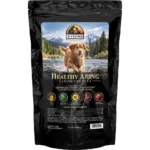
Foods that list Medium Chain Triglyceride Oil
1 food in our catalog lists it, highest on the label first.
Sources
What we read
Checked October 1, 2026.
- 1 A randomised trial of a medium-chain TAG diet as treatment for dogs with idiopathic epilepsy
- 2 A multicenter randomized controlled trial of medium-chain triglyceride dietary supplementation on epilepsy in dogs
- 3 Dietary supplementation with medium-chain TAG has long-lasting cognition-enhancing effects in aged dogs
- 4 Efficacy of a Therapeutic Diet on Dogs With Signs of Cognitive Dysfunction Syndrome (CDS): A Prospective Double Blinded Placebo Controlled Clinical Study
- 5 Triglycerides of medium-chain fatty acids: a concise review
- 6 Oral Palatability Testing of a Medium-Chain Triglyceride Oil Supplement (MCT) in a Cohort of Healthy Dogs in a Non-Clinical Setting
- 7 Medium Chain Triglycerides (MCT) Oil
- 8 Medium-chain triglycerides (MCT): suitable for weight control?
- 9 A randomised trial of a medium-chain TAG diet as treatment for dogs with idiopathic epilepsy: corrigendum
- 10 Animal Food Labeling and Pet Food Claims